The State of Design & Make Special Edition | Spotlight on Rail
New research shows the rail industry's top challenges are talent (31%) and sustainability (26%). Complex data management is also a major issue. Leaders are addressing these through digital transformation. Read the special edition report for more details.
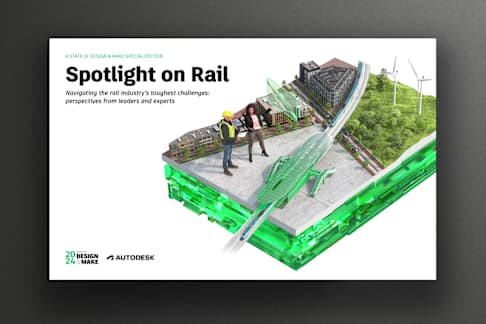
A STATE OF DESIGN & MAKE SPECIAL EDITION
Spotlight on Rail Navigating the rail industry’s toughest challenges: perspectives from leaders and experts
2 SPOTLIGHT ON RAIL
Global demand for rail is growing fast: passenger and freight activity are set to more than double by 2050.1 That’s no surprise, considering many countries want to achieve net-zero goals despite the fact that our population will increase by nearly two billion in the next 30 years.2 For many governments, a solution to this growing problem is rail. Rail can provide large urban communities with safe, easy transportation that they’re already familiar with—all while involving up to 80% lower carbon emissions than flying.2
Introduction
Investments are already reflecting this shift. Governments around the world are planning to create new networks and redesign and update historic lines to better support modern society’s needs. The United States, for instance, has announced $1.4 billion in infrastructure funding for 70 rail improvement projects.3 India’s government has announced $32.7 billion for rail in its national budget.4 And the EU has made €25.8 billion available for grants to co-fund projects, including high-speed railways across member states.5
For organizations in the rail industry, this means the pipeline of work is healthier
than ever. But a shortage of skilled talent has contributed to a major need for better workflows and methods to deliver the growing number of projects efficiently.
To learn how rail organizations are tackling these challenges, Autodesk interviewed 30 rail industry leaders and experts from across the globe during its recent Rail Summit industry event in Amsterdam. Together with insights gathered from Autodesk’s 2024 State of Design & Make report, this special edition will share more about the actions they are taking to prepare for the future via digital transformation.
2x both rail passenger and freight activity is set to more than double by 2050
3 SPOTLIGHT ON RAIL
“Talent is a big problem,” agreed a BIM portfolio manager at the Rail Summit. “Finding people who are experienced in digital transformation is key to being able to manage the transition process—that’s what’s currently missing.”
Finding talent is especially problematic as there’s a disconnect between more experienced professionals who offer a wealth of knowledge and IP and less experienced team members who are more at home with technology. “We have to make sure we find people who can be
comfortable working in a digital space,” a director of BIM explained. “That’s a challenge for us, like it is for everyone, as it’s only the younger people who seem completely comfortable with it.”
While the next generation will likely be trained primarily using digital solutions, this needs to be done without3 losing all the insight that’s been gathered over years of experience.
Ongoing challenges:
Talent, sustainability, and information management
Today’s railway organizations face many competing pressures to address cost control and climate change, all while working on increasingly complex projects. However, the industry faces stark realities in this modern economy when it comes to talent. According to Autodesk’s 2024 State of Design & Make report, 31% of civil engineering professionals say attracting, training, and retaining talent is currently their top challenge.
Railway leaders face ongoing challenges
SECTION 1
As well as talent, sustainability continues to be a crucial consideration, with 26% of leaders and experts saying it is a top challenge they are facing today. As the infrastructure sector shifts to implement carbon management solutions such as the PAS 2080 certification6, more new rail projects need to be built with carbon footprints in mind throughout their entire lifecycle, from design and construction to operation and end-of-life. According to a BIM manager who attended the summit, “Sustainability is fundamental, and we help our clients by building that in up front, even if they don’t see why it’s important. It’s about our own business resilience, staying ahead of the curve.”
Rail industry leaders also reported that their teams were required to collaborate on complex projects across time zones, disciplines, and remote work, which makes information management challenging. One BIM manager at the summit explained that their biggest challenge is the vast amount of data needed on projects, as well as getting that data to the right places at the right times.
26% of leaders and experts consider sustainability to be a top challenge they are facing today
4 SPOTLIGHT ON RAIL
SECTION 1
5 SPOTLIGHT ON RAIL
Twenty-nine percent of civil engineering leaders said improved productivity was a key benefit of digital transformation. Andreas Rau, head of product management at Max Bögl, noted that many civil infrastructure customers believe that it takes more than 20 years to design and build a new public transportation line— but, in reality, digital workflows have now shrunk that process to less than five years. For many, this is because digital transformation involved switching to a cloud-based platform, giving teams a single source of truth to collaborate from. “Integrating both in a single platform and database allows different teams to communicate better, share information that otherwise would not be easily accessible
29% improved productivity and data exchange
As infrastructure continues to evolve at a rapid pace, a shift towards cloud-connected, data-driven approaches has become key to successful digital transformation. Respondents in Autodesk’s 2024 State of Design & Make report cited several major benefits:
The benefits of digital transformation
Thirty percent of respondents in the civil engineering sector said one of the top benefits of digital transformation was a better reputation for their business. Many respondents also said digital transformation enabled them to more easily and effectively present work to clients. For example, Teknik Engineering converted a high-speed train megaproject from 2D to 3D. This allowed the team to quickly offer solutions to the client before the project had even been assigned to them, helping to eventually secure the business.8
30% better customer satisfaction
Twenty-five percent said digital transformation made it easier to plan and make better business decisions. Consultancy firm Ramboll, for instance, uses BIM to create realistic 3D maps that help plan effective sound barriers along rail routes while preserving natural habitats.7
25% better decision making
SECTION 2
by all, and ensure all variables and factors are carefully assessed and taken into account at any point in time during the lifecycle of an infrastructure or part of it,” affirmed Marcella Faraone, FS Technology BIM & GIS team leader.
6 SPOTLIGHT ON RAIL
Improved profitability was also seen as a top benefit of digital transformation for 28% of respondents in the civil engineering sector. Teams can use a cloud platform as a single source of truth, which helps them avoid expensive errors and make better decisions about everything from sustainable building materials to safety-conscious suppliers. This also gives them absolute visibility and accountability across every decision and milestone in every project phase, from the early planning of railway infrastructure to managing it once it is built.
For 22% of respondents, better risk management was also seen as a key benefit of digital transformation. For example, many are mitigating future risk by performing clash detection with unified project data and design automation, which has allowed teams to forecast accuracy and reduce the amount of rework required on projects. Thirty-five percent are taking this further by using artificial intelligence (AI) in their company for workplace safety and risk analysis.
28% 22% improved profitability reduced risk
Leaders and experts across all industries say digital transformation made it 59% easier to plan and make better business decisions and improved data exchange by 62% and customer satisfaction for their company by 64%
SECTION 2
7 SPOTLIGHT ON RAIL
As increasingly severe weather events continue to disrupt infrastructure worldwide, rail organizations are preparing for a more sustainable future by building resilient transportation infrastructure. This is especially crucial in countries like the US, where many infrastructure systems were created for the population and climate of the mid-20th century. Because of this, many systems are well beyond their design life expectancy (essentially, how long a product is expected to work or last, based on its design).
For many, digital technologies are key to updating rail infrastructure so that networks can continue to be safe and
“I think the intervention of technology is essential. Projects should be incorporated with the latest technology so that if we revamp it down the line, maybe in 30 years, 40 years, 50 years or 100 years, we know what exactly we built and what again, we have to build on it. So it becomes very easy if we do it through technology.”
—Sekh Samim, Deputy Chief Architect, Delhi Metro Rail Corporation Limited
reliable, despite a lack of skilled industry talent.
Digital twins—dynamic, up-to-date representations of a physical object or system—are one of the key technologies being used for this purpose. The early implementation of a digital twin for Istanbul railways, for instance, enabled teams to examine equipment status so they could predict maintenance before failure occurred. It also helped analyze and improve power consumption. This improved operational and maintenance efficiency by 15–37.5%, which in turn saved 12–25% on energy consumption and maintenance costs.
Other leaders and experts are using virtual reality (VR) on their projects, which helps them to win new business. Siemens Mobility, for instance, has replaced traditional presentations with VR to take non-technical stakeholders both inside and outside the trains. This helps customers to better understand different ideas and for the Siemens Mobility team to iterate through different design options for the trains.
“As we prepare for the future, to me being resilient means several things,” concluded a BIM manager at the Autodesk Rail Summit. “Ensuring that we integrate sustainability in everything we do, recruiting people who can carry digitalization forward with us, and fully embracing digital transformation so we are always ahead.”
According to Autodesk’s most recent State of Design & Make report, 83% of leaders and experts are feeling customer-driven pressure to strengthen sustainability goals, and 78% are committed to their sustainability initiatives, prioritizing them as a key part of their business growth strategy for the next three years. Sixty-seven percent of respondents also said sustainability goals are no longer a nice-to-have, but a requirement of modern business.
Preparing for the future of rail SECTION 3
The combination of automated, driverless operation also reduces running costs by 20% compared to conventional wheel-rail systems. “The TSB can be scheduled to run on demand, which avoids empty journeys in off-peak hours and in rural areas,” says Andreas Rau, product manager for the TSB. This reduces wear and tear on trains, making them even more cost-effective.
Max Bögl, a German construction and infrastructure company, is using digital technology to bring a new urban transportation solution to life. Called the Transport System Bögl (TSB), the train works with magnetic levitation (maglev) technology. This means that despite achieving a speed of 150 km/h (95 mph), the TSB is quieter—emitting almost zero noise and no vibrations.
8 SPOTLIGHT ON RAIL
SECTION 3
Max Bögl relies on 3D models to draw potential customers to the new technology. “In order to provide a realistic representation of what the track will look like for a particular route, we use Autodesk software and a selection of camera tracking shots with tight curve radii of up to almost 150 feet, as well as steep gradients of up to 10%,” Rau explains.
This project has set an important foundation for the future—it’s enabled the Max Bögl team to create a demonstration track in the southwestern Chinese province of Sichuan and convinced the Federal Ministry of Transport and Digital Infrastructure (BMVI) in Germany to conduct a feasibility study into using the TSB at Munich Airport.
The combination of automated, driverless operation reduces running costs by 20% in comparison to conventional wheel-rail systems
Image courtesy of Max Bögl
If there is one overarching takeaway from both the Autodesk Rail Summit and State of Design & Make report data, it is this: As rail industry leaders plan for the future, digital technologies will be key to increasing resilience and overcoming top challenges such as talent shortages, decarbonization, crumbling infrastructure, and data management of complex projects.
This increased resilience is crucial, especially as investments in rail are increasing around the globe. As the demand for projects grows, digital transformation will be key to helping organizations maintain and modernize rail networks while building in a sustainable way.
Conclusion
9 SPOTLIGHT ON RAIL
About Autodesk’s 2024 State of Design & Make Research The State of Design & Make report is a global, annual study for leaders who design and make places, objects, and experiences. It identifies the most pressing drivers of change that are shaping today’s business decisions to help leaders prioritize and invest in the future.
In the most recent report to be published in April 2024, Autodesk surveyed 5,368 leaders and experts in the architecture, engineering, and construction (AEC); design and manufacturing (D&M); and media and entertainment (M&E) industries.
Spotlight on Rail focuses on the quantitative data from professionals in civil engineering (n=277). The quantitative data was collected between July and September 2023, through a 20-minute online survey, including responses from Australia, Brazil, China, India, Japan, South Korea, France, Germany, Italy, Mexico, the Middle East, the Netherlands, the Nordics, South Korea, Spain, Sweden, Turkey, the United Kingdom, Canada, and the United States.
About The Rail Summit The Autodesk Rail Summit is an annual event, held most recently in September 2023 in Amsterdam, that brings together rail industry leaders and experts from across the globe to share valuable insights into outstanding projects.
Connect with a worldwide community of rail industry leaders, innovators, and experts in Autodesk’s new online Rail Community. It’s a place to share thoughts and ideas and build lasting connections. We invite you to join and contribute to the discussions at https://autode.sk/railcommunity.
Or, learn more at https://autodesk.com/industry/railway.
Sources 1. https://www.iea.org/reports/the-future-of-rail 2. https://www.un.org/en/global-issues/population 3. https://railroads.dot.gov/about-fra/communications/newsroom/press-releases/biden-harris-administration-announces-14-billion-0 4. https://www.railjournal.com/financial/india-announces-us-32-7bn-capital-investment-in-rail-in-national-budget/ 5. https://cinea.ec.europa.eu/programmes/connecting-europe-facility/transport-infrastructure_en 6. https://www.bsigroup.com/en-GB/our-services/product-certification/product-certification-schemes/pas-2080-carbon-management-in-infrastructure-verification/ 7. https://www.autodesk.eu/customer-stories/ramboll-vr-railroad-design 8. https://www.autodesk.com/customer-stories/teknik-engineering
Autodesk is changing how the world is designed and made. Its technology spans architecture, engineering, construction, product design, manufacturing, and media and entertainment, empowering innovators everywhere to solve challenges big and small. From greener buildings to smarter products to more mesmerizing blockbusters, Autodesk software helps customers design and make a better world for all. For more information, visit autodesk.com or follow @autodesk on social media.
Contact Autodesk at state.of.design.and.make@autodesk.com about this research report or to sign up to participate to future research programs.
The information provided in this report is for general informational purposes only and strictly for the convenience of our customers. Autodesk, Inc. does not endorse or warrant the accuracy or completeness of any information, text, graphic, links, or other items contained within the report. Autodesk, Inc. does not guarantee that you will achieve any specific outcomes or results if you follow any advice in the report.
Autodesk, Inc. does not guarantee that you will achieve any specific outcomes or results if you follow any advice in the report.
© 2024 Autodesk Inc. All rights reserved